
How to Avoid Running Out of Money in Retirement
Remember the classic 1980s commercial featuring Fred the ...
Receive a complimentary copy of The Wells of Wealth System after your call →

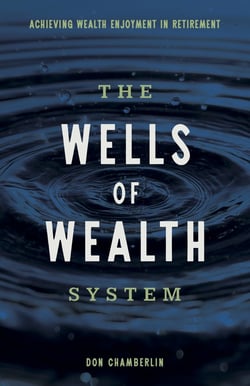 At a Glance: The Wells of Wealth System
In our last post, we asked, "Where’s the Beef?"—pointing out that many 401(k)s are all "fluffy bun" (accumulation) with no "beef" (reliable income).
In Chapter 1 of our CEO Don Chamberlin’s new book, The Wells of Wealth System, we dive into the cautionary tale that started it all: the 1993 "Got Milk?" campaign. Just like the history buff who knew the right answer but couldn’t be understood because his mouth was full of peanut butter, many retirees have the "right" amount of savings but lack the "liquid" strategy to make it work when they need it most.
Running out of money in retirement is a lot scarier than running out of milk. In a recent survey, 64% of Americans said they are more worried about running out of money in retirement than they are about death. To avoid that outcome, you have to understand the three lethal risks that most typical advisors aren't talking about.
Wall Street loves to talk about "average rates of return," but averages are a trick. If you have $1 million and lose 30%, you have $700,000. Most people think a 30% gain gets them back to even—but the math of loss shows that a 30% gain only gets you to $910,000. You actually need a 43% gain just to break even. In retirement, you don't have the "investment energy" or the time to wait for those massive rebounds.
When you are working, you have a long runway to build speed. But in retirement, that runway shrinks. We call this Sequence of Returns Risk.
Imagine two sisters, both retiring with $1 million and averaging the same 5.9% return. Sister One hits a market downturn in her first few years of retirement, while Sister Two hits that same downturn 20 years later. The result? The "lucky" sister has over $2 million left after 25 years, while the "unlucky" sister runs out of money 18 years in. You can’t control the market's timing, but you can control how your wealth is allocated to protect against it.
Are you swimming with weights on? From expense ratios to active management fees, many investors are paying for "pros" who only beat the market 8% of the time. As fiduciaries, we believe in evidence-based investing: using low-cost, academic strategies that rely on facts and data rather than hype or high-priced "guesses".
You wouldn’t wait for a plane to crash before checking the fuel gauge. Whether you are in the Accumulation, Planning, or Decumulation phase, you need a strategy that shifts the goal from growing wealth to enjoying it.
Ready to give your portfolio a "milk mustache"?
Schedule a no-fee, 20-minute strategy session with a certified Retirement Educator. They aren’t there to sell you products; they are here to help you understand your risks. When you call, we will mail you a free copy of The Wells of Wealth System and discuss your eligibility for a complimentary "mini-plan," which includes:
Not sure what to ask your Retirement Educator? Here are a few questions that can help you get oriented at the start of your planning journey:
Most people focus on the total balance of their 401(k). As you approach retirement, though, your focus should shift to cash flow. How much of your wealth is liquid and reliable (your future “Liquid” and "Conservative” wells), versus how much is subject to market swings that could disrupt your monthly income?
This is a "stress test" question. Your retirement educator can explain the "Sequence of Returns" risk — the danger of the market dropping right as you start taking withdrawals, leaving you behind for your entire retirement and in danger of outliving your money. They’ll explain the importance of a "buffer" to protect your lifestyle during a downturn.
Tax rates are not static. If the majority of your money is in a traditional 401(k) or IRA, you have a "lien" on your account held by the IRS. Ask the educator how you can balance your "Growth Well" with tax-advantaged accounts (like a Roth) to ensure you aren't losing 25–30% of your future spending power to taxes.
Social Security shouldn't be viewed in a vacuum; you have to look at your retirement holistically. The goal is to find the "sweet spot" where you maximize your lifetime benefits while using your private savings to fill the gaps efficiently. When you file can have other effects on your long-term plan as well, with the formula for survivor and spousal benefits taking the timing into account.
Pro Tip: Whenever you talk to a potential financial planning partner, listen for whether they give you a "one-size-fits-all" answer or if they ask follow-up questions about your specific goals. The best strategy is always the one most tailored to you and your needs, goals and dreams.
• • • • •
Chapter 1: Got Risk? The 3 Biggest Reasons Why People Run Out of Money
Chapter 2: Have It Your Way: 5 Steps to Planning Your Retirement Income
Chapter 3: An In-Depth Look at The Wells of Wealth and How They Really Work. Keep an eye out in May!
In the meantime...
As of the writing of this book and blog post, the author is an investment adviser representative and supervised person of Foundations Investment Advisors, LLC (“Foundations”), an SEC registered investment adviser. The opinions and assertions expressed in this book are solely those of the author and do not necessarily reflect the views of Foundations. Foundations’ involvement with this book has been limited to performing a high-level compliance review. No compensation related to this book will be directly or indirectly shared with or remitted to Foundations.
This book includes, among other things, general concepts about investment strategies, including retirement-focused strategies, some of which are explained in the book through the use of case studies and examples. Nothing in this book is intended to provide any specific or targeted investment, financial, tax, or legal advice. Individuals are strongly encouraged to consult with their own investment, financial, tax, and legal professionals regarding these matters.
The use of brand names and mention of specific commercials herein is for educational purposes only and does not constitute or imply endorsement from Wendy’s, McDonalds, Burger King, the California Milk Processor Board, the National Milk Processor Education Program (MilkPEP), Dunkin’ Donuts, Butterfinger candy bar, Big Red gum, Toys "R" Us or any other company or brand.
The stories and characters in this book are purely fictional or are based upon real-life events that have been both anonymized and modified. Each story combines facts and circumstances that have been redacted or modified to highlight the subject matter of each chapter. These facts and circumstances are not intended to represent any one client, either in part or in whole, and they are included solely as educational tools. No story should be interpreted as applying to any reader's or person’s individual situation or circumstances or be construed as personalized investment advice. Always consult with your tax professional, attorney, and financial adviser regarding such matters.
Any statistical data or information included herein has been obtained from third-party sources believed to be reliable; however, neither Foundations nor any third-party has independently verified such data and information. Foundations does not guarantee its accuracy or completeness, and neither Foundations nor the author has any obligation to, nor will they, update information that is later determined to be inaccurate for any reason (including becoming stale or outdated).
A Roth conversion may not be suitable for your situation. The primary goal in converting retirement assets into a Roth IRA is to reduce the future tax liability on the distributions you take in retirement, or on the distributions of your beneficiaries. The information provided is to help you determine whether or not a Roth IRA conversion may be appropriate for your particular circumstances. Please review your retirement savings, tax, and legacy planning strategies with your legal/tax advisor to be sure a Roth IRA conversion fits into your planning strategies.
.jpg)
Remember the classic 1980s commercial featuring Fred the ...
.jpg)
Have you ever wondered why retirement planning feels so much ...

Your retirement plan shouldn’t be a cookie-cutter, ...